Discover
Plan your visit
People often ask what they need to do before visiting an Orthodox church. The honest answer: nothing. The main thing is simply to be here. Everything below is just detail — useful detail, but detail.
When to come
The best first visit is the Divine Liturgy — every Sunday at 10:00am. It is the main service of the week, the whole parish is there, and it is sung in English. There's no need to book and no one will single you out. If you arrive and the service is already underway, don't worry — push on the door and let yourself in quietly. People arrive when they are ready, and come and go more than you might expect.
What it's like
The Liturgy lasts around two hours. You'll notice at once that worship engages all the senses: icons and candlelight, incense, and almost everything sung rather than said — mostly in English, without song books. Some people join in with the singing; many simply listen. Both are fine.
Most people stand for much of the service — standing makes you a participant rather than a spectator — but chairs are there, and you are welcome to sit whenever you need to; nobody will give it a second thought. When the clergy come out from behind the iconostasis into the body of the church, carrying the Gospel or the Holy Gifts, you'll see everyone who is able stand — as a visitor you may like to do the same.
You'll see people crossing themselves, lighting candles, kissing icons, moving about. Some do, some don't. Do whatever you find most helpful — which may simply be staying where you are and taking in the sights and sounds of it all. Being present is enough. You are not expected to behave in any special way; all we ask is that you be reverent.
So many icons
Icons cover an Orthodox church because each one points to something bigger than itself — like a family photo album covering twenty centuries, reminding us of the family's history, and of our gratitude to those who have gone before us. Each icon carries a story worth discovering, and together they say that the Church spans heaven and earth.
Before the icon of Christ we remember His life, death and resurrection — every Orthodox service is a celebration of the resurrection. The icon of the Mother of God (the Theotokos, “the one who gave birth to God”) recalls her “yes” to God. And the saints, ancient and modern, fill seemingly every spare surface.
You may see people kissing the icons. Orthodox Christians do not worship icons — we reverence them: honour given to an image passes to the one it depicts, just as kissing a photograph of someone you love honours the person, not the paper. Icons also quietly affirm the heart of our faith — that God became a human being in Jesus Christ, who could be seen, and so can be depicted.
Incense
One of the first things you may notice is the smell of incense, used to give honour to God since Old Testament times. The altar is censed because it is the throne of God; the icons, because they are images of Christ and His saints; and the congregation too — because they are the people of God, each made in His image. That includes you. When the censer swings your way, nothing is expected of you; some people give a small bow.
Is there a collection?
No basket comes round. There is a box in church for donations towards the parish's work, and giving is entirely optional — as a visitor, please feel no obligation at all; you are our guest.
Holy Communion
Communion is the high point of the Liturgy, and is received by Orthodox Christians who have prepared for it. As a visitor, simply stay in your place when others go forward. At the end of the service, though, blessed bread called the antidoron is shared with everyone present, visitor or regular — please do take some. It's an expression of fellowship, and a practical kindness too: Orthodox Christians will have been fasting since the evening before.
What to wear
There is no dress code. Most people dress simply and modestly; some women choose to cover their heads, but it is entirely optional. Comfortable shoes are a good idea if you plan to stand.
Children
Children are part of the congregation, not a distraction from it. Babies make noise; ours do too. Bring them.
Come alone, or be met
If you'd like to slip in at the back, say your prayers and slip out again, that is absolutely fine. But if you'd rather not walk in alone, ring Father George beforehand and we'll make sure someone is looking out for you — to greet you when you arrive and answer questions during or after the service.
The main thing is to be here
All of the above is just detail. The Divine Liturgy is a framework within which, in the company of worshipping Christians, you can meet with God. Whatever background you come from, come expecting that — and be welcome.
Find us
Where to come
126 Staveley Street, New Edlington, Doncaster, DN12 1BP
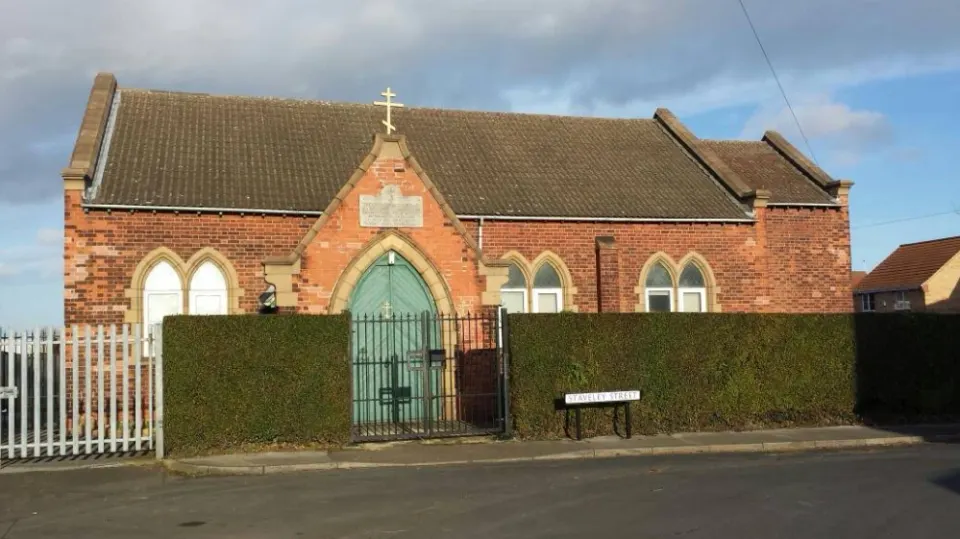
Full written directions are on our Find us page.
Still wondering about something?
Get in touch — no question is too small. Phone, email or a written message: all the ways to reach us are on the contact page.